When hope is hard to find, I might be looking on the wrong bookshelf.

I haven’t been feeling very inspired this year. Most of the things I write are meant to inspire in some way or at least point towards where hope might be discovered. Last week I wrote an annual report for work and was aware that part of the purpose of that was to express gratitude for work done by great people in the last year and it was also about capturing a positive vision of the year to come that people might get behind. It was relatively easy to make that hopeful, but I am finding that kind of positivity more challenging when it comes to writing this blog and Sunday sermons in particular.

Round 2 of President Trump, which began in January, had me addicted to news feeds for a while. “Drill, baby drill,” he said on day 1, confirming his lack of regard for the sustainability of our planet. It wasn’t as memorable as his claim that the concept of global warming was invented by the Chinese to undermine US markets, or his quip about rising sea levels creating more ocean front properties, but it was just as depressing.

In the weeks that followed I found myself scrolling through news feeds and getting more and more alarmed. J.D. Vance visited Europe and was spectacularly offensive and angry, revealing a mindset that seemed to see the 1930s not so much as a warning from history but a manual for success. President Zelenskyy, whose country was invaded by Russia, visited the White House and was bullied by Trump and Vance in a scene that was less reminiscent of The West Wing than Goodfellas. It seemed like the gangsters were in charge.

Meanwhile not so far behind the scenes, Elon Musk and Trump collaborated to remove voices of dissent from positions of influence, and continued to work towards the monopolisation of information channels so that disinformation could become more the norm. They tried to label this free speech when it is anything but. Indeed, in my day job I often teach critical thinking classes, and it really does feel like there are a lot of people not only in the United States but around the world who desperately need to develop their fact-checking skills. As that great President of another era, Abraham Lincoln, once said, “The problem with quotes on the internet is it’s hard to verify their veracity.”

In those early weeks I watched the news and followed social media feeds too much. I would look at my phone and immediately feel angry at what was going on but I was always desperate to find out more. After a while, though, I realised that this was not doing me any good and decided to withdraw from news and social media not completely but enough to connect to wider realities and ways of seeing the world. I had a stack of books that I had been given for Christmas. Perhaps these would help.

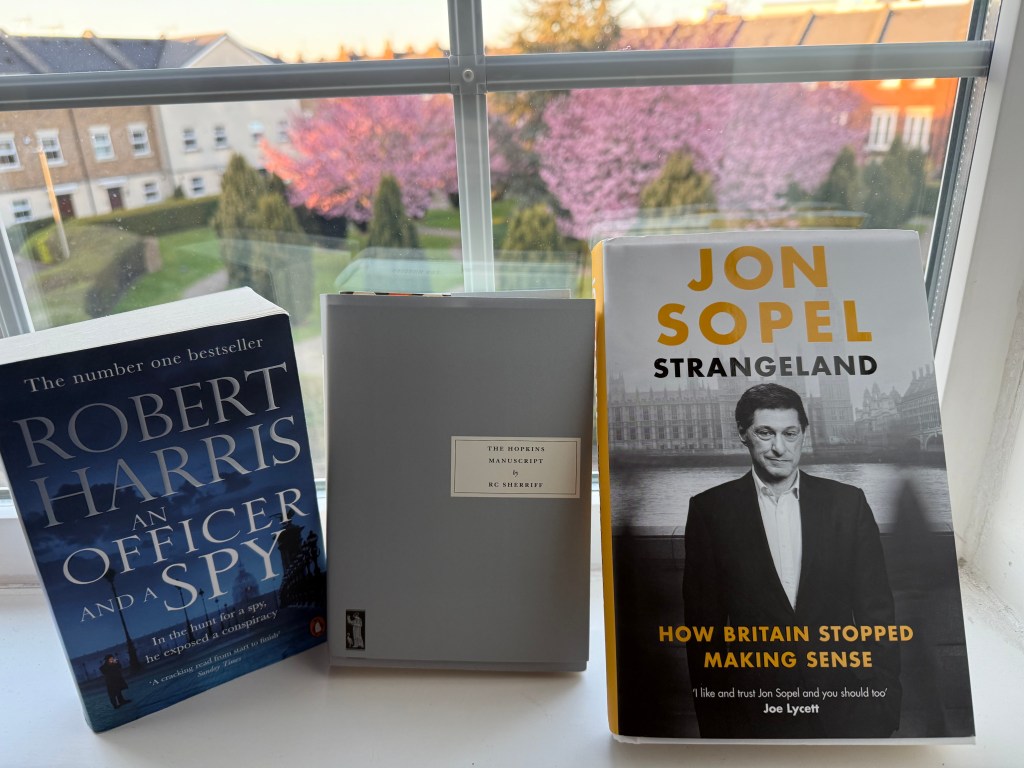
The first book I read was Robert Harris’ compelling novel An Officer and a Spy, which is about the Alfred Dreyfus scandal that rocked France at the end of the nineteenth and beginning of the twentieth centuries. It’s a riveting book but at its heart it is a warning about what can happen when people prioritise their allegiance to particular individuals or personalities over systems of law and justice. It made me think of the current situation and was thus not escapism.

I read Jon Sopel’s excellent book Strangeland, which to be fair didn’t even promise to be escapism because it is his thoughts on returning to the UK after living in the US for several years and finding that he didn’t recognise the place anymore. At first I found the style of the book a little annoying, as Sopel writes in speech rather than prose, meaning his punctuation is all over the place. However, I effectively received a telling off from Stephen King on this when I read his book On Writing, in which he argues that punctuation should not always be made to dress up in formal attire; sometimes we should allow it a day in leisure-wear or even a full on pyjama day in which semi-colons are locked in a literary chest of drawers and capital letters are not made to get up off the couch because sometimes the effort is too much.

To return to Strangeland, however, Sopel shows how intertwined the stories of Britain and the United States are and at the book’s heart is incredulity about how an event as clearly undemocratic and hate-fuelled as the January 6th riots on the Capitol building could now be so easily brushed under the carpet of history. My thought by the end was ‘You ain’t seen nothing yet.”

Another book I read for escapism is The Hopkins’ Manuscript, which is a terrific science fiction novel first published in 1939. The world is about to suffer a terrible catastrophe as the moon is on a collision course for Earth and the end of everything is predicted. In the event quite a lot of people survive the catastrophe but (spoiler alert) then different countries go to war over the mineral rights and real estate value of the moon. Responding to human suffering by going after mineral rights and real estate. Who would do such a thing?

And that’s the trouble isn’t it? We cannot escape from the world as it is no matter how much we try and nor should we be able to, for in troubled times there are people who need our support, issues to campaign on and needs to be met, but we do need to look after ourselves so perhaps a step away from the news scroll is no bad thing.

As I write this it’s a beautiful spring day in Cheltenham, X is long since deleted from my phone and today I have had good conversations with nice people. It’s not all bad news out there and if I can’t always be persuasively hopeful, I can at least point towards those who can. Kate Rusby has recorded a new song with Barnsley youth choir – you may find it more inspirational than this blog.

Celebrating 2024: Garrison Keillor

Back in the mid-90s, before we all got distracted by the internet, in a time when people didn’t get excited by phone updates because a phone was just a thing attached to the wall that distracted you by ringing every time you took a bath, I was influenced by Garrison Keillor.

 I first read Garrison Keillor’s Lake Wobegon Days in the late eighties or nineties, and then when I went to college in Ripon, Wisconsin in 1993 there he was on the radio every week, presenting a weekly show that seemed to be from a different era despite its contemporary cultural references. Prairie Home Companion combined stories from Lake Wobegon with sketches from the Lives of the Cowboys and Guy Noir,  music from some of the great American folk and Americana singers of the time and faux-advertising from Powdermilk Biscuits and the Ketchup Advisory Board. It was gentle, warm and inoffensive and as I travelled around small town America as an undergraduate and then later for my PhD research, the whimsical qualities of Keillor’s depiction of small-town life played into my own feelings about these places where I enjoyed a warm welcome wherever I went. Because it was a time before the internet when life was less busy I even started writing my own midwestern stories, and looking back, I don’t think I started badly:

It was a wild land once. However, civilized times turned the midwest into a landscape of regimented fields of corn watched over by Sergeant⌐Major silos. A new arrival takes a wrong turn and travels ten to a place he has never been before only to find that it is, somehow, familiar. Everything is the same here to the eyes of the new arrival. He gets in his car and drives off wondering what the appeal of this part of the world could possibly be, searching for the meaning he might have found if he had stayed long enough to sample Ethel Ingersoll’s cherry pie.

Life has no point if you stay on the interstate. Anyone can do that. The interstate is just traffic travelling in two directions known as “there” and “back again”. Someone drives to the office, sits in his chair for eight hours wondering why, and then drives home again. “Back again” is that route which looks much the same as “there” and has no point except coffee stops, burgers and Dunkin’ Donuts. Life has no point if you stay on the interstate. Take the county roads. Better still, find a dirt track with ruts in it that challenge tyres and keep a person on edge. Get completely lost and you might find yourself where you want to be.

After a promising start that story took a left turn into absurdity and whilst I enjoyed writing my stories they all turned into indulgent shaggy dog tales with under-developed characters and wince-inducing punchlines. The first one, for example, was about an old soldier who lived to be over a hundred and attributed his longevity to the spoonful of gunpowder he put on his cornflakes in the morning. “It cleans out the tubes,” he explained. Several pages later the old soldier died leaving, as the last paragraph explained, a widow, three children, ten grandchildren, twenty-five great grandchildren and a huge crater where the crematorium used to be. I was, I learned, not a great writer of fiction.

Whilst I am no great writer of fiction, I can see the work of Garrison Keillor in various aspects of my life. For example, he once said,  “When in doubt, look intelligent,” which was a strategy I used to get through the first two years of my PhD, by which time it was too late for anyone to tell me how woefully underprepared and unqualified I was for the journey I was on. Later on, when I was writing a chapter on the pay and working conditions of Primitive Methodist ministers in Britain and the United States, I heard him tell a story of a Lutheran pastor contemplating asking for a pay rise with the words, “It’s kind of like asking for cheese on your communion wafer: you just don’t!” and I realised that in one line he has summarised the point of my entire chapter.

Like Keillor, I have always thought that humour is an important way of making sense of the world. “The highlight of my childhood was making my brother laugh so hard that food came out his nose,” he once said, but when I led a service on the theme of the spirituality of humour, the Garrison Keillor quotation I chose was this:

“Humor is not a trick or a joke put into words. It’s a presence in the world, like grace, and it’s there for everyone.”

Garrison Keillor mingles (Cadogan Hall, London)

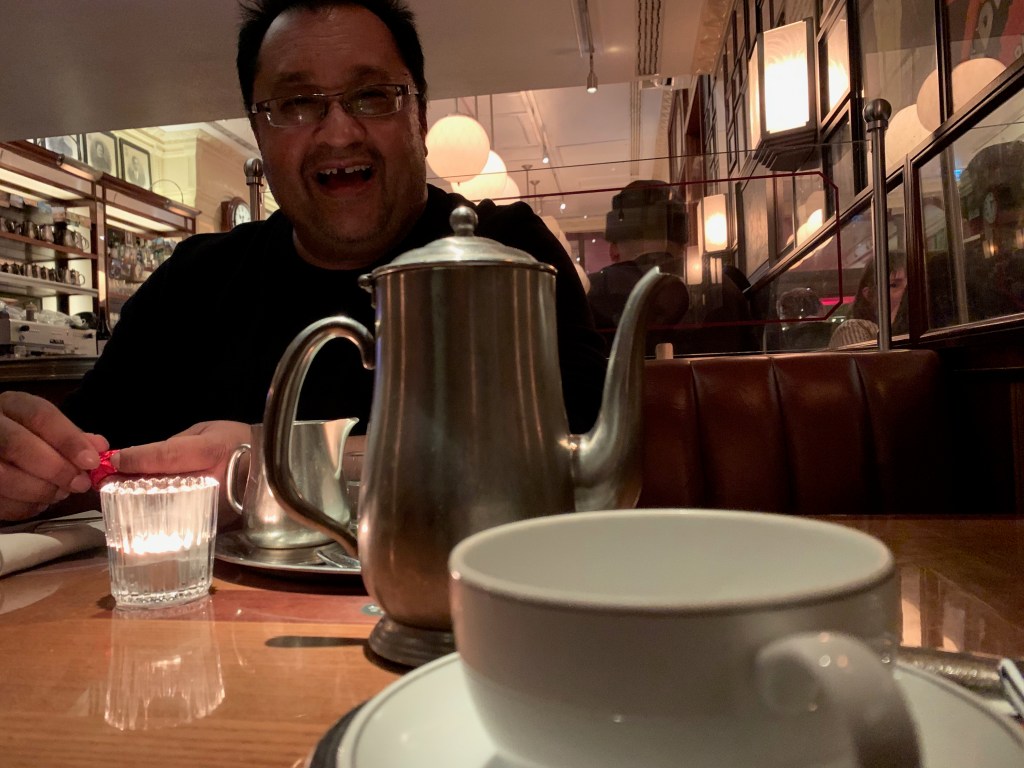
With all the above in mind, you will appreciate that I was excited to finally see Garrison Keillor live when he visited London in October. Accompanying me was my old friend, Ru, who enjoyed a few midwestern adventures with me many years ago. One of the many things I find fascinating about Garrison Keillor is the extent to which he comes across as a preacher, albeit one whose sermons are peppered with risque jokes that wouldn’t get past the pulpit censors. Keillor is 83 now and has difficulty moving around, but he mesmerised us for two hours with stories, hymns and occasionally risque jokes all around the theme of cheerfulness. We were made to sing together, laugh together and think together and when we came out Ru and I went for coffee and ice cream, for no better reason than that is something you can easily do in London at 10 pm on a Thursday evening. Ru shared stories of his dad, who passed away earlier in the year, and somewhere in the telling and the listening and reminiscing life felt deeper and richer. I came away grateful for the many adventures Ru and I have shared, grateful for all those visits to Lake Wobegon and places like it, and also grateful for the power that is to be found in telling our stories and listening to the stories of those with whom we travel.