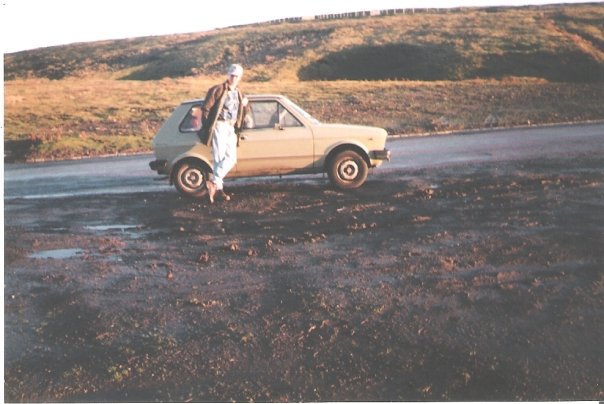
I have never cared that much about what car I drive. In my younger days I had some shockers. There was a brown Mini Metro that turned out to be biodegradable (the floor rusted through while I was driving it). I had a snot-green Yugo 45 that rarely started and when it did start it had a problem with petrol incontinence. I once parked that car on a hill in Weardale and the handbrake didn’t hold – it overtook me with no driver inside whilst I was walking down a hill but fortunately not so fast that I wasn’t able to jump in and avoid disaster. One of my cars met its end at a scrapyard in Sheffield. As I drove it there, a man behind me was completely engulfed in the thick smoke pouring from the exhaust. All I could see in my rearview mirror was his fist emerging from a cloud of fumes.
Most of the cars I owned in my younger days ought to have come with a slightly larger instruction manual than you normally get: Section 1 would be a list of features, section 2 would be the troubleshooting section and section 3 would be selected prayers of intercession for passenger and driver use on motorway journeys.
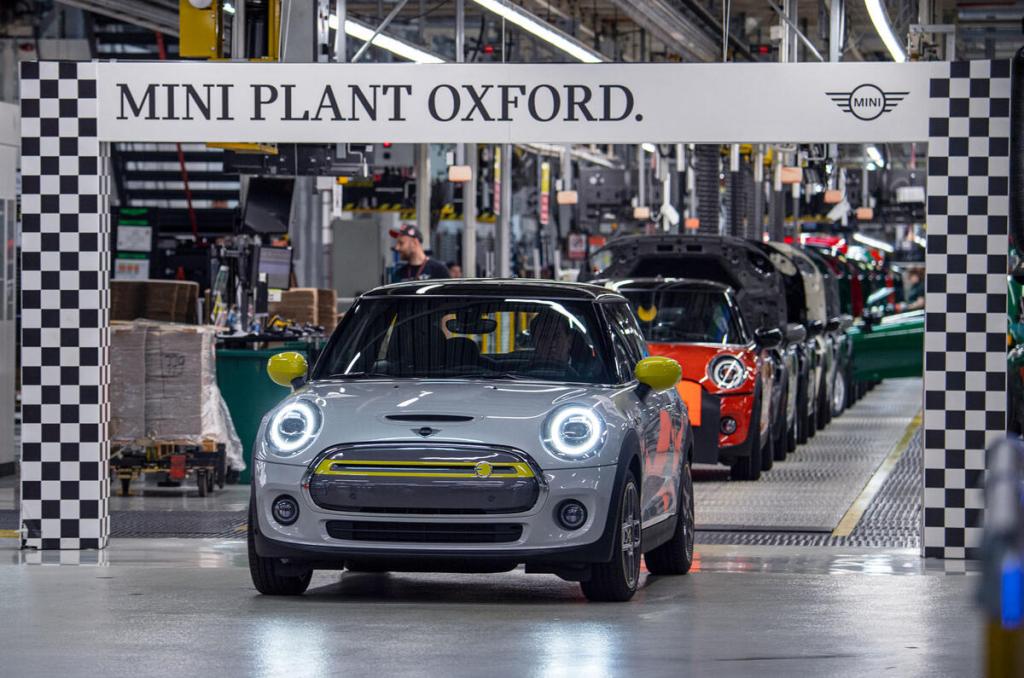
Tracey, on the other hand, has always liked cars and minis in particular. She bought one many years ago and it’s still going well and still looking good. With her passion for all things Mini in mind I booked us in for a tour of the mini plant in Oxford in the springtime and it ended up being perhaps the most extraordinary day of the year.
We have all seen videos of factories before but standing in a vast room full of robots working on minis felt very Blade Runner. Each robot had 65 seconds to complete whatever job it was doing before handing the car over to the next robot, to do its job. The tour took us through all the different stages of car production (a detail that I particularly remember is that female ostrich feathers are used for dusting cars in the paint shop before the application of paint). As we wandered around, we had to avoid the driverless vehicles that were moving around the plant: their journeys were perfectly timed to deliver the right part to the right place in the production line at just the right moment. We watched the human end of the production line, where people work on moving platforms to install electrics, seats and dashboards, each process completed with precision in under two minutes and whilst part of me recalled the dehumanization of the production line as so memorably spoofed by Charlie Chaplin in Modern Times, I also couldn’t help but be impressed by the innovation and efficiency of this place.
There’s a lot of very clever science behind the successful operation of the Mini plant and to me it was a reminder that there are a lot of incredible scientists out there who are worth listening to. It was a strange and possibly contradictory leap to make from car production to environmentalism, but during our visit I found myself thinking about something I heard Kevin Fong, the popular space scientist, writer and broadcaster say six years ago on the fiftieth anniversary of the first moon landing. He was talking about John F. Kennedy’s famous speech where he promised that the United States would go to the moon within ten years, and of course it happened. Armies of scientists had to work with precision on every detail but it happened. Fong argued that if such a commitment was made today to put the same amount of effort into addressing the issues of climate change, then scientific innovation really could turn things completely around. It was at the time an inspiring thought. Former US president Barack Obama, echoing the language of former Vice-President Al Gore has said rather more soberly, “It’s important to listen to what scientists have to say, even when it’s inconvenient; especially when it’s inconvenient.”
So today I suppose I am giving thanks for the scientists who make the world a better place and I am dreaming of a world where scientific evidence is revered as it should be and listening to such evidence is not considered optional. To put it more metaphorically, this old banger we call science has brought us a long way. Let’s not stall the engine now.
May you receive the blessing of a reminder that we are all connected…and this can come in unexpected ways…serendipities, coincidences or synchronicities…however you understand it…
May I share a recent one that might ring a bell for you…
I try, when I can to buy books second hand…or ‘pre-loved’ if that sits better with you…
Over the past few years I have been trying to get my head around the concept of how people can do malicious or cruel acts to others, so jumped at an online training entitled; ‘Malice in Clinical Practice’ taught by a well respected clinician and trainer.
Her first and main reference was for a book written in 1989 called ‘the Tyranny of Malice’. In the tea break I went online and was pleased to see one for a few pounds and bought it. It arrived virtually the next day. In good condition and I started to read it.
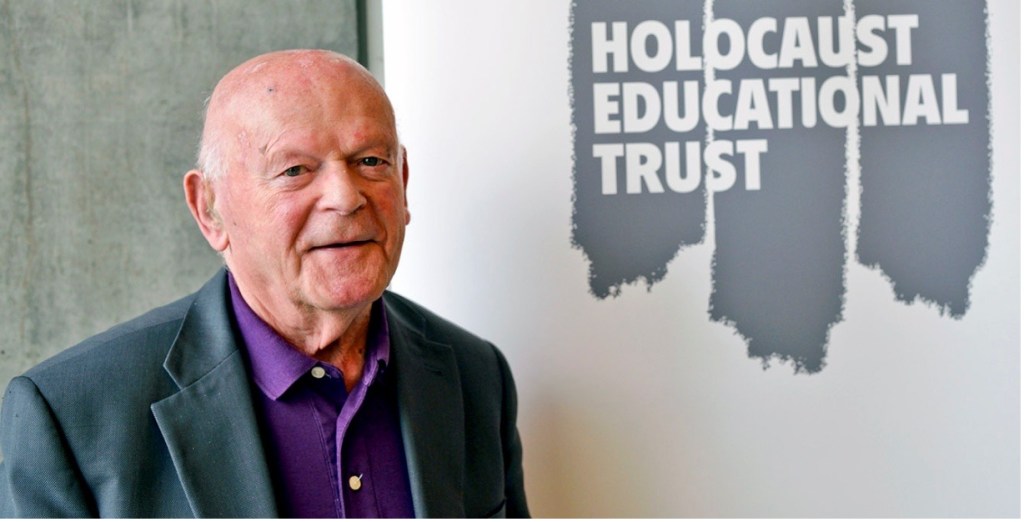
I noticed the stamp in the inside cover of its previous owner: the Library of Sir Ben Helfgott MBE.
I didn’t think any more of this…until yesterday when, having a few moments to spare I put this gentleman’s name into Google…
Reading about his life and recent death, aged in his nineties gave me a shudder and then insight as to why this book had been in his library…
He was a survivor of one of humanity’s worst crimes against their fellow man.
Initially sent to Buchenwald, aged nine, Helfgott survived the Holocaust but was very weak, and was liberated in 1945. He was among 732 orphan refugees under the age of 16 brought to England after the war by CBF World Jewish Relief after being liberated from Theresienstadt; he formed a part of the initial 300 arrivals and thus of the group known as The Windermere Children who were sent to Troutbeck Bridge on arrival. He and one of his sisters (Mala Tribich) were the only members of his family to survive the war; his mother and youngest sister were rounded up and shot by the Nazis.
He campaigned that the holocaust must not be forgotten…and also seems to have wanted to make sense of and explore the dark side of character and culture…the focus of the book that has connected me with this amazing man…
I feel extremely honoured and humbled to have his book and wonder where this connection will lead me now…
May blessings of connection open up for you this Advent and may you be open to the gift they bring you.
I’m not a big fan of middle-of the-plate food. If we go out to eat, I want a good portion that goes right to the edge of the plate, not a lonely morsel in the middle surrounded by a sea of empty porcelain. If you pay to eat out, you shouldn’t feel the need to stop off for snacks on the way home, and the kind of place I like has waiters that don’t wince when you ask for ketchup.
My palate may not be sophisticated but I do like food and in June Tracey and I found ourselves in a wonderful Thai restaurant in Ambleside where the portions were good and the company even better (I have to say that of course, but it’s true). It was a lovely meal but for me the highlight, the moment of culinary ecstasy was a dessert that had a delicious warm doughnut exterior but on the inside it was packed with creamy ice-cold ice cream.
This dessert was a thing of beauty that Sunday night to match the Lakeland hills that surrounded me and the fact that all these months later I am still remembering it with a smile is a reminder of the importance of celebrating simple moments of life.
About twenty years ago I cited an American minister in a sermon that was all about the importance of simple pleasures. Unfortunately, I can’t find a record of who he was, but I will repeat his words below because they speak rather more eloquently than my ice cream doughnut of the transformative potential there is in celebrating simple things:
During my first year in theological school I was in despair about life, my own included. One cold, dreary Chicago day during the worst of it, wandering aimlessly along 63rd Street, going silently crazy, I suddenly, without intending or willing it, turned and stepped into a fresh fruit bar and ordered a glass of orange juice.
I drank it unthinkingly, then tasted the juice, the pulp. And slowly something happened. The orangeness of that orange juice, its sweetness and sunfilled-ness, the feel of it going into my throat and into my body, awakened me. I remember mumbling to myself how those oranges were doing good by me, actually caring for me without my asking, and the least I could do was say — if not “thank you” — at least “okay”.
Maybe if oranges could be such a pal — zinging good things through me — why not other things? The sun, the air, the sidewalk, the music pouring from the bells of Rockefeller Chapel across the midway. I finished my orange juice, walked back to the Meadville Library, wrote an A paper on Luther and the Anabaptists and went on into the ministry.
May you have the blessing of meeting a Goldcrest on a winter’s walk…
I have just had a quick nip out with the dog…both well wrapped up, but I’d left my gloves at home so my hands firmly pocket planted…there is still snow on the escarpment and a bitter wind.
And I heard a different squeaking in a nearby tree. We stopped to better listen and looked up to identify the squeak’s source
My eyes adjusted to see a tiny yellowy green brown bird flitting from branch to branch… a Goldcrest! …Apparently the adults weigh the same as a 20p coin…they are the UK’s smallest bird.
I felt truly blessed to be in the company of this minute miracle of nature…reminding me of Julian of Norwich’s words when holding a small nut in her hand…and marvelling at it’s smallness is told that ‘It is all that is made’ and ‘endures because God loves it.’.
May we all endure this Advent’s busy times knowing that we are truly loved…
Today may you have the blessing of picking something up, at home, and finding that long lost special thing beneath it…you perhaps put it somewhere for safe keeping…you got distracted…and then began to lose hope of ever finding it…
Until…
It reminds me of the words in the hymn Amazing Grace; ‘I once was lost but now I’m found…’
This brings together all those loose ends into something more coherent; those times when we do indeed feel lost…lost amongst the chaos and the clutter of life; the tiredness after a fretful night. Feeling ragged and not quite sure of our direction.
Perhaps a well timed cup of tea, finding that lost something or other, just noticing a glimmer of beauty even in the dying flowers can help us feel ‘found’ again…
May the blessing of ‘feeling found’ be part of your Advent path….
Driving home from work the other night I listened to the first in this year’s series of Reith lectures delivered by Rutger Bregman, whose excellent book Humankind inspired me several years ago, with its positive perspective on what humanity could be. In the lecture this week, Bregman was less positive than he sounded in his book (and this was before the BBC censored a line), and who can blame him in the year that is 2025? I have not fact-checked his lecture, but at one point he gave some sense of the horror of the war the world has seen this year when he referenced Israel dropping “the equivalent of six Hiroshima’s worth of bombs on Gaza.” What a deeply horrifying thought that is in a year which our daily news cycle has given so little scope for hope. The United States elected a new president who on day one denied the reality of climate change and whose agenda seems to be replacing the democratic forms of government that have served well for so long with a cruel authoritarianism made in his own image. There are also echoes of Trump in the UK, where right-wing populism has gained a foothold and the racism at the extreme end of anti-immigration rhetoric is becoming more normalised, fuelled to some extent by social media misinformation.
2025 has been a year when I have heard that sense of diminished hope expressed by people in church and in my work in a university, where high fees and modern day pressures are having a detrimental effect on curiosity. Indeed, in his Reith lecture, Rutger Bregman mentioned the American Freshman survey, which since the 1960s has monitored the values of students in the United States. In the early years students prioritised finding a good philosophy of life on their journey, and making money was lower on the agenda, but today this has apparently flipped and finding a philosophy of life is less important than before. I am not sure whether the same pattern is evident in the United Kingdom, but it feels like many students today are living in the shadows of diminished possibilities.
I don’t have the answers to any of the above, but as we enter into advent I am reminded that the Christian Christmas story is one of hope being born in a cold cruel world. I am also reminded that to some extent we have to construct our own realities. Perhaps in the grey moments of life we need to seek out the colour a bit more. Perhaps in hard times our friends can also help us see what is good.
With that in mind throughout advent I am inviting people to share their blessings of 2025. What follows is 24 blog posts of advent positivity, 24 blessings for which a variety of people have chosen to give thanks. At the time of writing, there is still plenty of room for more submissions, so if you wish to please send some words and a picture if you have something you don’t mind sharing of something that has given you a sense of blessing in 2025. Send your entries to cheltglosunitarians@gmail.com
On Sunday 28 December we will have a service at Bayshill Unitarian Church in Cheltenham celebrating some of the blessings that have come up. We could do worse than to use this adaptation of a Fransiscan benediction, which I offer as a blessing for day 1:
Day 1: A Fransiscan Benediction
May God bless us with discomfort At easy answers, half-truths, and superficial relationships So that we may live from deep within our hearts. May God bless us with anger At injustice, oppression, and exploitation of God’s creations So that we may work for justice, freedom, and peace.
May God bless us with tears To shed for those who suffer pain, rejection, hunger, and war, So that we may reach out our hands to comfort them and To turn their pain into joy.
May God bless us with just enough foolishness To believe that we can make a difference in the world, So that we can do what others claim cannot be done: To bring justice and kindness to all our children and all our neighbors who are poor.
And may God bless us with an appreciation of our aliveness, Our knowledge that we are still here and the world still turns, And in that world we appreciate laughter and sunshine, The books on our shelves, the people in our lives, The small details that make our lives complete.
May God bless us and help us be a blessing to others.
I haven’t been feeling very inspired this year. Most of the things I write are meant to inspire in some way or at least point towards where hope might be discovered. Last week I wrote an annual report for work and was aware that part of the purpose of that was to express gratitude for work done by great people in the last year and it was also about capturing a positive vision of the year to come that people might get behind. It was relatively easy to make that hopeful, but I am finding that kind of positivity more challenging when it comes to writing this blog and Sunday sermons in particular.
Round 2 of President Trump, which began in January, had me addicted to news feeds for a while. “Drill, baby drill,” he said on day 1, confirming his lack of regard for the sustainability of our planet. It wasn’t as memorable as his claim that the concept of global warming was invented by the Chinese to undermine US markets, or his quip about rising sea levels creating more ocean front properties, but it was just as depressing.
In the weeks that followed I found myself scrolling through news feeds and getting more and more alarmed. J.D. Vance visited Europe and was spectacularly offensive and angry, revealing a mindset that seemed to see the 1930s not so much as a warning from history but a manual for success. President Zelenskyy, whose country was invaded by Russia, visited the White House and was bullied by Trump and Vance in a scene that was less reminiscent of The West Wing than Goodfellas. It seemed like the gangsters were in charge.
Meanwhile not so far behind the scenes, Elon Musk and Trump collaborated to remove voices of dissent from positions of influence, and continued to work towards the monopolisation of information channels so that disinformation could become more the norm. They tried to label this free speech when it is anything but. Indeed, in my day job I often teach critical thinking classes, and it really does feel like there are a lot of people not only in the United States but around the world who desperately need to develop their fact-checking skills. As that great President of another era, Abraham Lincoln, once said, “The problem with quotes on the internet is it’s hard to verify their veracity.”
In those early weeks I watched the news and followed social media feeds too much. I would look at my phone and immediately feel angry at what was going on but I was always desperate to find out more. After a while, though, I realised that this was not doing me any good and decided to withdraw from news and social media not completely but enough to connect to wider realities and ways of seeing the world. I had a stack of books that I had been given for Christmas. Perhaps these would help.
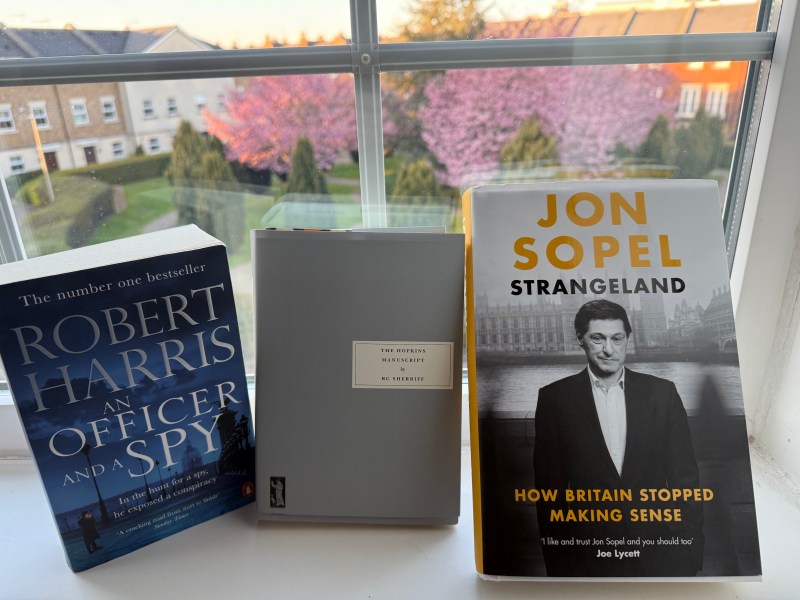
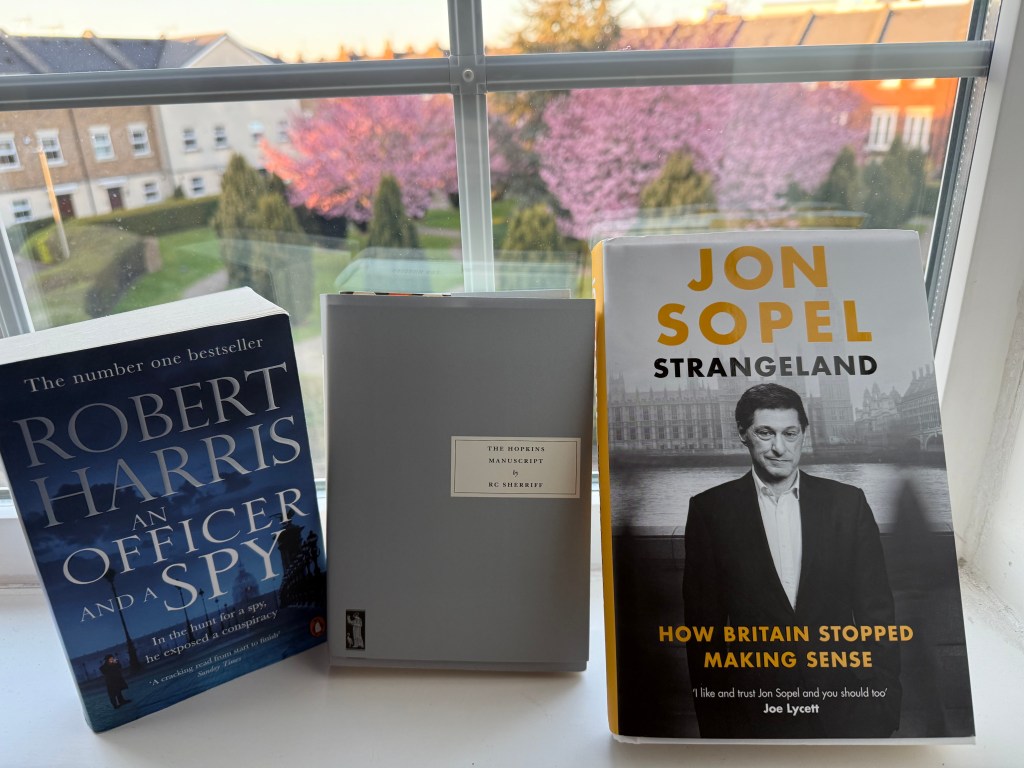
The first book I read was Robert Harris’ compelling novel An Officer and a Spy, which is about the Alfred Dreyfus scandal that rocked France at the end of the nineteenth and beginning of the twentieth centuries. It’s a riveting book but at its heart it is a warning about what can happen when people prioritise their allegiance to particular individuals or personalities over systems of law and justice. It made me think of the current situation and was thus not escapism.
I read Jon Sopel’s excellent book Strangeland, which to be fair didn’t even promise to be escapism because it is his thoughts on returning to the UK after living in the US for several years and finding that he didn’t recognise the place anymore. At first I found the style of the book a little annoying, as Sopel writes in speech rather than prose, meaning his punctuation is all over the place. However, I effectively received a telling off from Stephen King on this when I read his book On Writing, in which he argues that punctuation should not always be made to dress up in formal attire; sometimes we should allow it a day in leisure-wear or even a full on pyjama day in which semi-colons are locked in a literary chest of drawers and capital letters are not made to get up off the couch because sometimes the effort is too much.
To return to Strangeland, however, Sopel shows how intertwined the stories of Britain and the United States are and at the book’s heart is incredulity about how an event as clearly undemocratic and hate-fuelled as the January 6th riots on the Capitol building could now be so easily brushed under the carpet of history. My thought by the end was ‘You ain’t seen nothing yet.”
Another book I read for escapism is The Hopkins’ Manuscript, which is a terrific science fiction novel first published in 1939. The world is about to suffer a terrible catastrophe as the moon is on a collision course for Earth and the end of everything is predicted. In the event quite a lot of people survive the catastrophe but (spoiler alert) then different countries go to war over the mineral rights and real estate value of the moon. Responding to human suffering by going after mineral rights and real estate. Who would do such a thing?
And that’s the trouble isn’t it? We cannot escape from the world as it is no matter how much we try and nor should we be able to, for in troubled times there are people who need our support, issues to campaign on and needs to be met, but we do need to look after ourselves so perhaps a step away from the news scroll is no bad thing.
As I write this it’s a beautiful spring day in Cheltenham, X is long since deleted from my phone and today I have had good conversations with nice people. It’s not all bad news out there and if I can’t always be persuasively hopeful, I can at least point towards those who can. Kate Rusby has recorded a new song with Barnsley youth choir – you may find it more inspirational than this blog.
Orton Methodist Church is a place I visited many times in my childhood, but my trip there on 7th June was, I believe, my first this century. This was a place I sat in fairly regularly as a child because it was the church in which my dad grew up and one set of grandparents were stalwarts there. As I sat in a pew towards the back on that warm night in June, I recalled my grandparents sitting near the front nearly half a century earlier, my grandad pelting out all hymns at full volume, which made it much more of a noticeable statement when he skipped a line to register his disapproval of words he did not agree with. For him a chief offender was Yes God is good, which includes the line ‘Yes God is good all nature says,’ something he didn’t agree with because he would argue you don’t have to look very hard at the world of nature to see violence and suffering. The hymn was written by John Hampden Gurney, who was from London and educated at Cambridge, but probably didn’t strike my grandad as someone educated in country ways and maybe that was why the hymn romanticised nature to the extent that it did.
I have tried to keep the opinionated family tradition of not singing particular lines of hymns going most noticeably by abstaining from singing the third line of the following verse in One more step along the world I go (the line is in bold below):
Give me courage when the world is rough
Keep me loving though the world is tough
Leap and sing in all I do
Keep me traveling along with you
To leap and sing in all we do would not be a good thing in my opinion. Is the job of a window cleaner not hazardous enough without introducing this new expectation? As someone who has had a lot of dental surgery this year, I’m not keen on dentists doing this either, and clearly if undertakers lived by this philosophy they would go out of business because you need a certain level of decorum in that profession. Leaping and singing undertakers is generally not a thing people are looking for. For me, leaping and singing have their place, but rarely on Mondays or before morning coffee. Of course this is a hymn designed for children and I don’t really object that strongly to its over-simplification, but every time I’m in a congregation singing it, I skip the line as tribute to the late George Watson, who regularly stopped singing for a line and meant it.
I was back in Orton Methodist Church for a celebration of Orton Male Voice Choir, of which my father is the only surviving founding member and he had come out of retirement for the night to share stories of the early days interspersed with the choir singing some of the hymns and songs that were meaningful to them. He did a really good job and was as relaxed speaking in public as I had ever seen him largely because for him this was very much coming home. My mother was also there and my brother, Nigel and I wondered if, like me in his mind Nigel wandered back to days of childhood when we sat through services that were rarely designed for children but gave a young mind some space and time to aimlessly wander. I usually started in those days by reading the names on the war memorial on the wall, which I always found interesting even before I knew what they were. Years later I encountered in the American Primitive Methodist Journal a story of a young boy talking to his grandfather and asking what the war memorial at the back of a church was all about and the grandfather, trying to choose his words carefully, said, “Well, this is a tribute to all the men in our congregation who died in service,” and the little boy nodded and then asked, thoughtfully, “Was that the 10.30 or the 6 o’clock?”
I suppose all those years ago I was a bit like that little boy. I wasn’t sure what I was reading but the names became familiar and the dates seemed like an impossibly long time ago. I would read them several times like we used to read cereal packets repeatedly because in those days that was the only entertainment available at breakfast time. If you were a child in the seventies you might recall this kind of conversation:
“Do you want this box of Shreddies?”
“No, I’ve read it already.”
So I would read the war memorial with a certain reverence for times past and we would sing hymns, then in between hymns my mind would wander and then sometimes, if you were in chapel for a ‘do’ (always referred to in letters by my grandmother as a ‘doo’ which is a spelling that seemed to have a little bit of traction locally a few decades ago) there would be tea and sandwiches and cakes afterwards. A strong memory of a ‘do’ was that at Orton they always insisted on bringing the tea out to the congregation who were instructed to remain in the pews. This made being a tea drinker a real act of faith because the hosts would come out with enormous metal teapots, and lean over several people to pour boiling hot water into the teacup you proffered above your lap. I was astonished in June to see that they are still doing that, as far as I know with no injuries to date. One miss though and to coin a phrase of Mark Twain, it might inspire some words that “aren’t Sunday School words.”
Tea anxiety aside, it was a very pleasant evening and I learned quite a lot about my dad’s early Methodist experiences that I hadn’t heard before. I also met some new people and some people I had not seen in years. There is, however, a strange thing that happens at a certain age when your waist has expanded and you have parted company with your hair and you meet someone you haven’t seen in decades whose reaction to seeing you is a look of puzzlement at the extent to which you have changed. When they say “hello” it might loosely be translated as “What happened?”
What happened I suppose is life. The people we meet, experiences we have, and second portions we fail to resist turn us into different people and there is a need to love the moments we are in and not cling too tightly to the past. Still, it meant something to read that war memorial again, to see people and think back to long gone days in this place when time seemed to stand still, an experience that even as a child was more comforting than boring. Always in the chapel people made a fuss and were pleased to see you and they still do, something I tend to think matters above most other things.
At the end of the night, the congregation sang Rock of Ages, which turns out to be a favourite of my dad’s but one I am theologically a long way removed from. I could have stood there and not sung, or missed out the lines I didn’t particularly like but there is a time for that and there is also a time when it’s less about the words you sing and more about being a part of the choir.
So whenever you next can, make a joyful noise by singing with others. Leaping, however, is optional, especially if you are driving a teapot.
Back in the mid-90s, before we all got distracted by the internet, in a time when people didn’t get excited by phone updates because a phone was just a thing attached to the wall that distracted you by ringing every time you took a bath, I was influenced by Garrison Keillor.
I first read Garrison Keillor’s Lake Wobegon Days in the late eighties or nineties, and then when I went to college in Ripon, Wisconsin in 1993 there he was on the radio every week, presenting a weekly show that seemed to be from a different era despite its contemporary cultural references. Prairie Home Companion combined stories from Lake Wobegon with sketches from the Lives of the Cowboys and Guy Noir, music from some of the great American folk and Americana singers of the time and faux-advertising from Powdermilk Biscuits and the Ketchup Advisory Board. It was gentle, warm and inoffensive and as I travelled around small town America as an undergraduate and then later for my PhD research, the whimsical qualities of Keillor’s depiction of small-town life played into my own feelings about these places where I enjoyed a warm welcome wherever I went. Because it was a time before the internet when life was less busy I even started writing my own midwestern stories, and looking back, I don’t think I started badly:
It was a wild land once. However, civilized times turned the midwest into a landscape of regimented fields of corn watched over by Sergeant⌐Major silos. A new arrival takes a wrong turn and travels ten to a place he has never been before only to find that it is, somehow, familiar. Everything is the same here to the eyes of the new arrival. He gets in his car and drives off wondering what the appeal of this part of the world could possibly be, searching for the meaning he might have found if he had stayed long enough to sample Ethel Ingersoll’s cherry pie.
Life has no point if you stay on the interstate. Anyone can do that. The interstate is just traffic travelling in two directions known as “there” and “back again”. Someone drives to the office, sits in his chair for eight hours wondering why, and then drives home again. “Back again” is that route which looks much the same as “there” and has no point except coffee stops, burgers and Dunkin’ Donuts. Life has no point if you stay on the interstate. Take the county roads. Better still, find a dirt track with ruts in it that challenge tyres and keep a person on edge. Get completely lost and you might find yourself where you want to be.
After a promising start that story took a left turn into absurdity and whilst I enjoyed writing my stories they all turned into indulgent shaggy dog tales with under-developed characters and wince-inducing punchlines. The first one, for example, was about an old soldier who lived to be over a hundred and attributed his longevity to the spoonful of gunpowder he put on his cornflakes in the morning. “It cleans out the tubes,” he explained. Several pages later the old soldier died leaving, as the last paragraph explained, a widow, three children, ten grandchildren, twenty-five great grandchildren and a huge crater where the crematorium used to be. I was, I learned, not a great writer of fiction.
Whilst I am no great writer of fiction, I can see the work of Garrison Keillor in various aspects of my life. For example, he once said, “When in doubt, look intelligent,” which was a strategy I used to get through the first two years of my PhD, by which time it was too late for anyone to tell me how woefully underprepared and unqualified I was for the journey I was on. Later on, when I was writing a chapter on the pay and working conditions of Primitive Methodist ministers in Britain and the United States, I heard him tell a story of a Lutheran pastor contemplating asking for a pay rise with the words, “It’s kind of like asking for cheese on your communion wafer: you just don’t!” and I realised that in one line he has summarised the point of my entire chapter.
Like Keillor, I have always thought that humour is an important way of making sense of the world. “The highlight of my childhood was making my brother laugh so hard that food came out his nose,” he once said, but when I led a service on the theme of the spirituality of humour, the Garrison Keillor quotation I chose was this:
“Humor is not a trick or a joke put into words. It’s a presence in the world, like grace, and it’s there for everyone.”
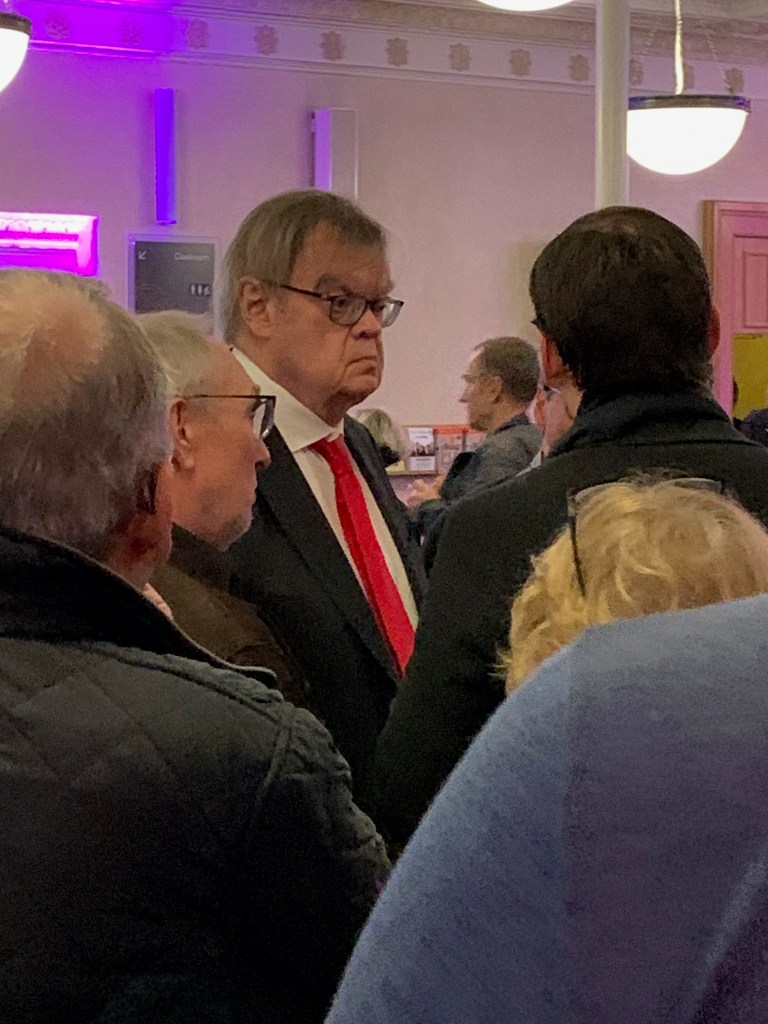
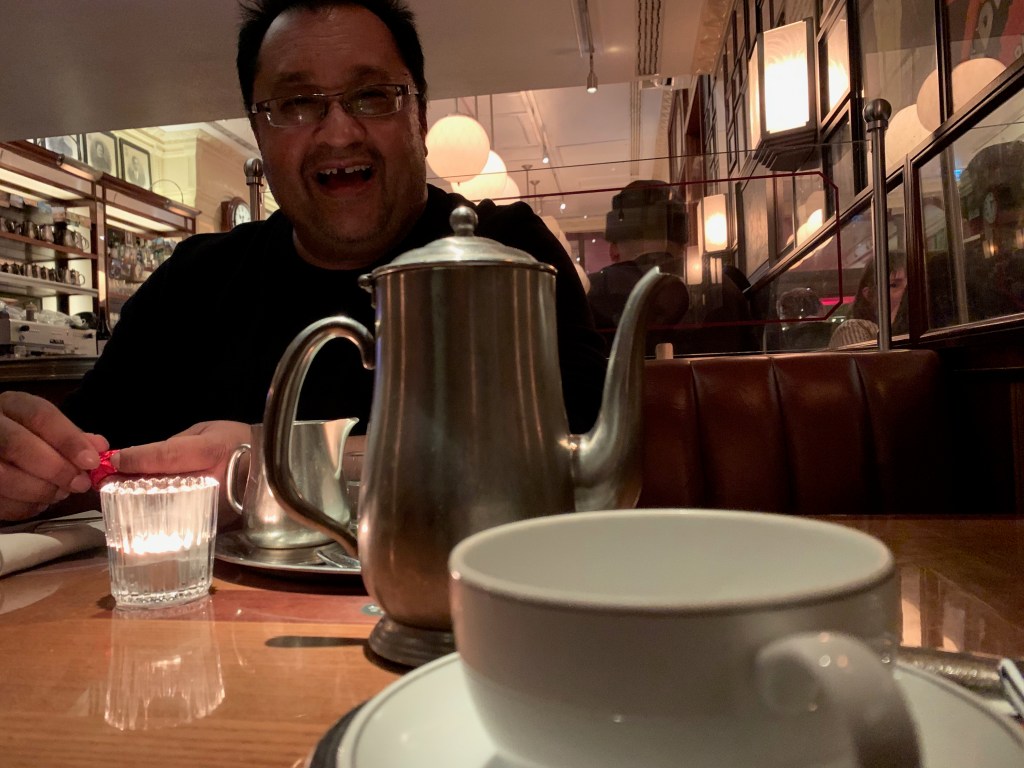
With all the above in mind, you will appreciate that I was excited to finally see Garrison Keillor live when he visited London in October. Accompanying me was my old friend, Ru, who enjoyed a few midwestern adventures with me many years ago. One of the many things I find fascinating about Garrison Keillor is the extent to which he comes across as a preacher, albeit one whose sermons are peppered with risque jokes that wouldn’t get past the pulpit censors. Keillor is 83 now and has difficulty moving around, but he mesmerised us for two hours with stories, hymns and occasionally risque jokes all around the theme of cheerfulness. We were made to sing together, laugh together and think together and when we came out Ru and I went for coffee and ice cream, for no better reason than that is something you can easily do in London at 10 pm on a Thursday evening. Ru shared stories of his dad, who passed away earlier in the year, and somewhere in the telling and the listening and reminiscing life felt deeper and richer. I came away grateful for the many adventures Ru and I have shared, grateful for all those visits to Lake Wobegon and places like it, and also grateful for the power that is to be found in telling our stories and listening to the stories of those with whom we travel.
February was an improvement on January. I lost no teeth, my car came back from the shop with a new bumper and when I looked in the mirror I thought I wasn’t looking bad for 55. Then I found my glasses.
February was the time in Cheltenham that daffodils started to appear, earlier than expected, like overly punctual guests who turn up at your house before you thought they really would. You are glad to see them, and their presence brings colour to a day that might otherwise have been grey, but you are not quite ready. If you had known they would be here this soon you would have started tidying up earlier or at least you would have redistributed the mess so that most of it was in one place that they wouldn’t see. “Don’t open that cupboard, Selwyn,” as a character in a largely forgotten sitcom of the 1970s used to say, “Things fall out.”
Just like we are not ready for the guest who arrives early, gardens are not ready for daffodils. They are a burst of colour whilst the rest of the garden looks lifeless and bedraggled. In the world of garden plants, the daffodil is the very loud annoying alarm clock that other plants want to ignore. “Wake me up at the end of April,” says the camelia plant, “I’m no good until I’ve had my first big cup of photosynthesis.”
As daffodils promised new life ahead, I sought out the liveliness to be found in my annual pilgrimage to the Bristol slapstick festival, a five day celebration of film and television comedy. This year I only managed a day and a half, but it is always a splendid thing to watch silent comedies with live musical accompaniment, though there was a moment of unanticipated slapstick when pianist John Sweeney poised his hands ready to accompany a Lloyd Hamilton film and a pre-recorded piano soundtrack started playing which he milked for comic effect to an extent that Rowlf from the Muppets would have appreciated.
Watch Lloyd Hamilton in Papa’s Boy and remember – ‘a butterfly in the net is worth two flies in the butter.’
Whenever I attend The Bristol Slapstick Festival, I am transported back in time to the summer of 2001, when I was a PhD student, and I got some funding to do some work in the Library of Congress in Washington DC for a couple of weeks. As well as my research, I managed to find time to visit the various monuments and museums, along with the National Cathedral, which is well worth a visit. I recall a little side chapel there with kneeling cushions embroidered with the names of past presidents. Apparently there are some presidents whose memory is too sacred for people to kneel on, so you can’t kneel on George Washington or Abraham Lincoln, but most other presidents are available. On the day I was there it seemed to me that the more famous the president was, the nearer the front they were positioned. I sat for a few moments in the back row and looked down at a cushion in memory of the largely forgotten Chester Arthur, president from 1881 to 1885, who served for a little short of one term and upon leaving office said, “There doesn’t seem to be anything else for an ex-president to do but to go into the country and raise big pumpkins.” I can certainly think of worse things an ex-president might do.
However, the reason that the Bristol Slapstick Festival takes me back to that summer in Washington D.C. is that whilst there I noticed in a local listings magazine that there was an event called Slapsticon taking place, at which they were showing old silent movies and I decided it would be nice to go along one evening. It was pretty unbearably hot, my accommodation had a fan but no proper air conditioning, and a night at Slapsticon might be both fun and a chance to cool off.
I took a train out to an Arlington convention centre where this event was taking place, and had a wonderful evening watching old movies starring silent comedians I had never heard of, but as the evening progressed it became obvious that I was the only casual visitor in attendance and that definitely I was the only person who had not arrived by car, a factor that was to prove important later on.
Spec O’Donnell – ‘Love’s greatest mistake’
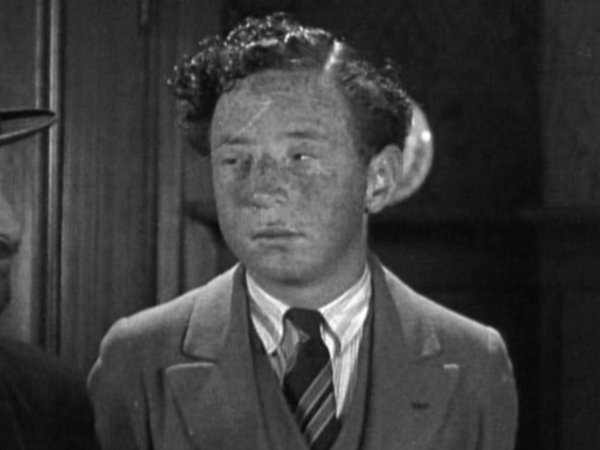
I was about to leave at midnight but a film came on called Pass the Gravy starring Max Davidson that had recently been deemed culturally significant by the Library of Congress. I decided to stay a little longer and I got really drawn into this tale of the unfortunate demise of Brigham the rooster, and I particularly enjoyed the performance of Spec O’ Donnell, the gawky looking teenaged comedy star who back in 1928, was billed as ‘love’s greatest mistake.’
There were more films to come but as the hour was late and I had to get back to my accommodation I decided to leave after Pass the Gravy. I left the convention centre’s cinema hall, crossed the foyer, went through a door that closed behind me and made for the pedestrian exit by which I had originally entered the building. The exit was locked. I decided to go back into the foyer and find an alternate exit but it turned out that the door I had just come through had locked behind me and I was stuck.
I spent a few minutes knocking on the door to try to get back in, but I probably did it with too much British reserve. When you are locked in a convention centre at 12.30 a.m. and no one is in sight, you probably need to make quite a bit of noise to get some attention but I was torn between that and my own embarrassment, and embarrassment won. Pretty much everyone in the building at 12.30 a.m. was watching the next movie and who was I to spoil their enjoyment?
Fortunately there was another door to the left of the pedestrian exit, which wouldn’t take me straight outside but I hoped it might take me to an alternate exit. I opened the door and saw a corridor, at the end of which was another door and the thought occurred to me that taking this path might make a bad situation even worse because of the tendency of doors to lock behind me. With that in mind I took what for me was an incredibly practical step and started tearing pages of the programme I had been given for the night’s entertainment. I went through the first door and used pieces of my programme to stop doors locking behind me.
It turned out that quite a few pieces of programme were needed for this job because this was a pretty big place with lots of corridors and offices, which, of course, were entirely empty at 12.45 a.m. on a Saturday morning. After the first couple of doors I was a little disheartened to discover that the only unlocked option available to me was to go upstairs, which did not feel like a promising route to freedom. I nearly went back towards the foyer but British reserve won and up the stairs I went.
There were more corridors, and more stairs and after a few more minutes of tentative wandering, the whole thing began to feel a bit like a soon-to-be victim in a horror film or a man on the run in one of those glossy Hollywood thrillers where the SWAT team suddenly appears and mayhem ensues. The fact that all these stairs and corridors looked the same didn’t help but what could I do? Somehow, forwards always seemed a better option than backwards.
After what seemed an eternity, but was probably just a few minutes and a couple of pages of programme, I encountered a sign that said ‘car park’, which I followed and despite being several floors up when I went through the door I was suddenly breathing the outside air of a warm summer’s night. I was in the convention centre’s multi storey car park and I reasoned that now all would be well (though in those glossy Hollywood thrillers I was just thinking about nothing good ever happens in a multi-storey car park).
I followed the signs for cars to exit as there was no obvious pedestrian staircase. The place seemed completely empty so it was perfectly safe to walk down the car ramps towards the exit and I smiled to myself as I recalled the comedy of the last few minutes.
My smile undoubtedly disappeared when I saw the ground floor big metal shutters that blocked my exit. Unless I could get those shutters open I was still trapped.
I wondered what would make those shutters open. There was no ticketing machine so it wasn’t that. Perhaps it was movement activated. I walked towards one of the shutters and waved my hands around.
Nothing.
It occurred to me that maybe it needed bigger movements so I took the late Magnus Pyke as my inspiration and waved my hands around a little bit crazily.
Nothing.
I reasoned that it could be the weight of a car that was needed to make the shutter go up and with that flawed logic of a panicked Brit abroad who had just had a slightly nightmarish journey through what seemed endless corridors of corporate sameness, my slapstickian alter ego took over. Yes, dear reader, I confess that at this moment I started jumping up and down and waving my hands in the hope that my weight, my movements, or my slightly unhinged state of craziness might open that shutter and liberate me.
Nothing.
I might have been spared the embarrassment that followed if I hadn’t decided to give it one more go with feeling. I jumped up and down with increased energy and freneticism, I waved my arms in the Magnus Pyke way and this time I shouted as well – at the shutter, at the absurdity of the night and at myself for not knocking a bit louder all that time ago when I was still near the foyer, and because of all I was putting into my crazy dance I failed to hear the sound of a car pulling up behind me, a car full of slapstick fans who had just spent a night watching crazy physical comedy from the 1920s only to encounter my real-life slapstick in the car park.
Purple-faced, I told them my story and when they stopped laughing we agreed that I was no Chaplin or Keaton and they kindly gave me a lift to the train station, though I think the person driving was never quite persuaded that I was a safe person to let in their car.
Since that memorable night back in 2001 I have attended many slapstick festivals but thankfully never again mirrored the entertainment to that extent.
At this year’s slapstick festival there was a new documentary about Laurel and Hardy that focused on their visit to Cobh in County Cork in 1953. As their boat approached the harbour they noticed crowds gathering and waving and as two entertainers who thought their glories were all in the past, they wondered what the fuss was all about. Stan Laurel himself described it this way:
“All the church bells in Cobh started to ring out our theme song, and Babe [Oliver Hardy] looked at me, and we cried. Maybe people loved us and our pictures because we put so much love in them. I don’t know. I’ll never forget that day. Never.”
For Stan Laurel it was remembered as perhaps the greatest day of his life, and perhaps it can be a reminder for us from the daft world of slapstick of the importance of celebrational moments.
In my own family there are some big special moments coming up in the next few weeks, the sixtieth wedding anniversaries first of my Uncle Bernard and Auntie Carol and then a week later my parents. There will be celebrations and lots of fuss and important memories made.
For my parents’ anniversary we are going to a hotel for an all-inclusive dining experience. There will be live entertainment, conversation and food, which may, of course, include pies.
Brian Bilson put out a poem this week on facebook called Mnemonic and it goes like this:
Thirty days hath September,
April, June and November.
Unless a leap year is its fate,
February hath twenty-eight,
All the rest hath three days more,
Excepting January,
Which hath six thousand,
One hundred and eighty four.
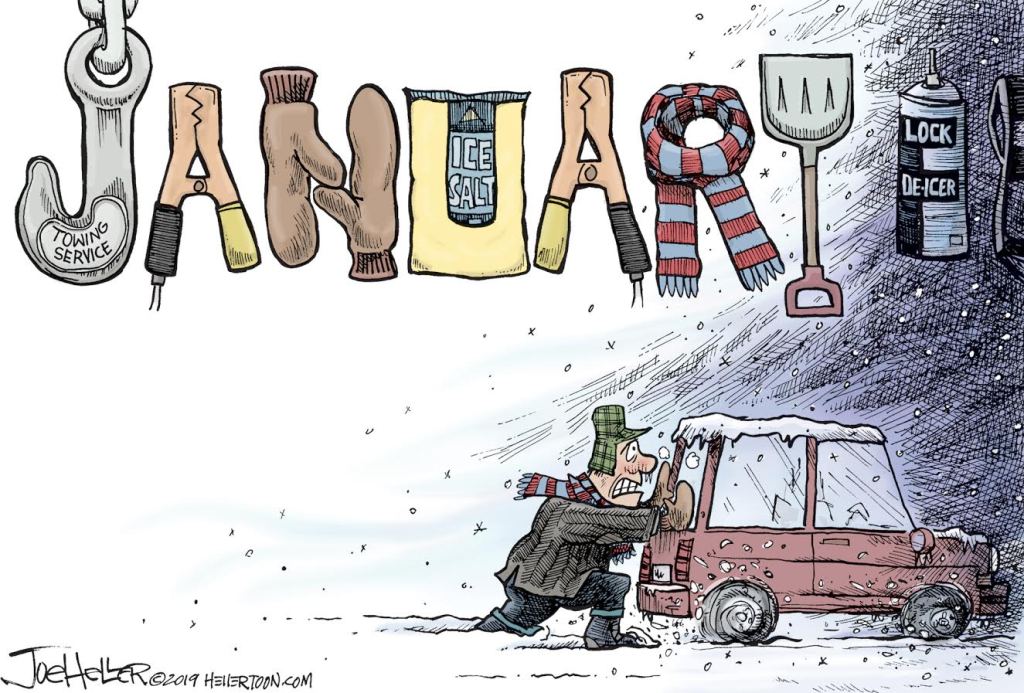
I related to that because it’s turning into one of those months when it’s dark and cold and things go wrong. At the beginning of the month I was suffering the distress of a car bump, which happened on one of those dark mornings where you get up and leave the house before you are awake and in this case it turned out that a neighbour had parked their car on the other side of the road opposite our house, and this car was a BMW that was exactly the same colour as a winter’s morning, especially one viewed through the less than perfectly clean rear window of my winter-filthed vehicle. The BMW was a nondescript grey, a car designed to blend into the background and I reversed straight into it, hitting what I thought was just the cold greyness of a winter’s morning with the nasty sound of scraping, crunching vehicular destruction. If you set off on a winter’s morning and you are not as awake as you should be, this kind of noise will get you as alert as you need to be for the rest of the day.
The BMW was not badly damaged but my car was looking decidedly less respectable than it had the night before, taking me in my mind back to some of the dodgy automobiles I had the misfortune to own in years gone by. There was a Yugo 45 with a petrol incontinence problem that meant that no one was allowed to smoke within ten feet of it and its fuel consumption probably meant I was driving in 1994 at 2024 prices. Often it wouldn’t start and I would imagine it talking to me saying ‘Yugo on ahead. I’ll just stay here.’ Before that there were a couple of mini metros, one of which came with green credentials – it was one of the world’s first biodegradable cars, by which I mean that in the end it got so rusty that the floor fell out while I was driving it. My cousin, David, recalls a sizable hole had appeared in the passenger side footwell, and one night he was a passenger when I drove through a puddle with a bit more speed than I should have done and he got drenched by the wave that caught him from head to foot.
I don’t miss those days of my youth when every time I got into a car there was the distinct possibility that it might not make it to where I was going, a time before mobile phones when you might have to walk for miles to get help. Once, back in the early 1990s, I had a flat tyre and when I looked in the car boot there was no jack for the car so I walked half a mile and borrowed a jack off a farmer. I then walked back to the car, changed the tyre, took the jack back to the farmer and thanked him, went back to the car and found I’d put the flat one back on. How would I not notice that? When I went back to explain I can remember that farmer didn’t say much, but the subtext of what he was trying not to say was that he thought I had some of my marbles, but definitely not all of them. He insisted on driving back with me and this time he changed the tyre for me whilst I stood by the road like a traffic light, feeling green and turning red.
In comparison to some of the things that have happened in the past, this latest incident is not much. It’s not even a good anecdote, but it’s no fun telling your neighbour you’ve bashed their car and dealing with insurance and so on. It is one of the things that has made January drag.
This month I have also been to the dentist for the beginning of some major dental work. On Friday I went in for an extraction and my new dentist greeted me in a rather funereal way, saying, “I’m sorry we are not meeting under better circumstances.” Of course, extractions aren’t fun but that seemed to me to be more sombre than was strictly required so I explained to the dentist that whilst the tooth she was taking out and I had travelled many miles together on the road of life, experiencing all the peaks and troughs that life throws at us, I did not feel a sentimental attachment to my tooth and it wouldn’t be upsetting for us to part company. The dentist nodded as if she understood, though the look she gave me did remind me of a farmer who once lent me a jack to change a tyre back in the early 1990s.
The tooth has gone now, but I got a better sense of what the dentist might have meant when she said “I’m sorry we’re not meeting under better circumstances’ when I saw the bill for the dental work I am supposed to be having in the next few months. It turns out having implants put into your mouth is an expensive business. If I go through with this, the contents of my mouth will be worth a bit – I might have to sleep with my head in a safe.
And so January goes on with cold mornings and deadlines and trying to keep the heating bills down by wearing so many layers I look like the Michelin man. Walking into work one day I told a colleague that underneath all these layers I am wearing is a man with a 28 inch waist and of course they weren’t amused but gave me the familiar slightly worried look of the farmer that lent me a jack all those years ago.
Perhaps winter makes us all more serious than is good for us. Maybe we should laugh a little more – watch a romcom, tell a joke, crack a smile, especially if you have one that you have had to pay a dentist lots of money to get. By the way, if you go to the dentist and they ask you to “open up,” try telling them you don’t know them well enough to share your personal feelings and you too can experience a certain worried look that I have come to know well.






 Living in the Moments