Day 19: Blessing of friendship by Anita Mansell

May you experience the pleasures of friendship that Stevie Smith talks about in her short but perfect poem :

The pleasures of friendship are exquisite,
How pleasant to go to my friend on a visit!
I go to my friend, we walk on the grass,
and the hours and moments like minutes pass.

The joy of sharing is so deep within us we often take it for granted. Recently I went for a walk with a dear friend and her dog. It was stunning, the sky was blue, the berries red and old man’s beard was draped over the bushes. I would have noticed all of this if I was by myself but somehow sharing it with a friend increased its wonderfulness.

At this time of year the focus is increasingly on the family. Some of us are blessed to have loving supportive families but many are not. This can be a difficult time for folk with the bombardment of images of happy families. Friends can also be family, close and caring and interested in each other’s lives. They are not always given the importance in our lives that I feel is valid.

So when we have a moment in this busy season, let’s give a moment’s breath to our friends and hold them close.

Day 19: Blessing of friendship by Anita Mansell

May you experience the pleasures of friendship that Stevie Smith talks about in her short but perfect poem :

The pleasures of friendship are exquisite,
How pleasant to go to my friend on a visit!
I go to my friend, we walk on the grass,
and the hours and moments like minutes pass.

The joy of sharing is so deep within us we often take it for granted. Recently I went for a walk with a dear friend and her dog. It was stunning, the sky was blue, the berries red and old man’s beard was draped over the bushes. I would have noticed all of this if I was by myself but somehow sharing it with a friend increased its wonderfulness.

At this time of year the focus is increasingly on the family. Some of us are blessed to have loving supportive families but many are not. This can be a difficult time for folk with the bombardment of images of happy families. Friends can also be family, close and caring and interested in each other’s lives. They are not always given the importance in our lives that I feel is valid.

So when we have a moment in this busy season, let’s give a moment’s breath to our friends and hold them close.

Day 18: A sacred text by Kevin Watson

The other day my dad gave me a book that meant a lot to me in my childhood and teenaged years. It was a book I handled reverentially because within its pages there were many wise lessons for a well-lived life. The book was Best Religious Jokes and when I opened it up, I realised that forty years later some of this material is still in my repertoire. Here’s one:

In the Sunday school class the teacher was going through the Ten Commandments and had just explained “Honour thy father and thy mother.” The teacher then  made the mistake of asking the children if they could think of a commandment that teaches how to treat our brothers and sisters. Little Jenny thought for a moment and then answered, “Thou shalt not kill.”


The broadcaster and writer Garrison Keillor is the person who first springs to mind when I think of the word ‘humourist.’ I have been a fan of his for years and finally saw him live last year. He once said, “Humor is not a trick or a joke put into words. It’s a presence in the world, like grace, and it’s there for everyone.”

As many people have pointed out there is humour in the Bible. If Jesus was working in comedy now he wouldn’t be winning Perrier comedy awards but he did use humour to make his point. The one that immediately springs to mind is his illustrating a message about hypocrisy with these ludicrous images: “Don’t try to take the speck of dust out of your neighbour’s eye when you have a plank of wood in your own.” “It is easier for a camel to pass through the eyes of a needle than for a rich man to enter the kingdom of God.” Or how about, “Be one guard against false prophets, who come to you as wolves in sheep’s clothing?” It’s like a scene from a Looney Tunes cartoon, this image of the wolf putting on the sheep outfit.


Elsewhere in the Bible we have the writer of Ecclesiastes effectively lampooning a overly negative world view with verses like: “Everything is pointless. The river flows into the sea but the sea is never full.” Other religious traditions also do comedy. The rhythm of this Buddhist joke is a little off but it is a funny two-liner:Ling-ien was asked: ‘How were things before Buddha came into the world?’ Ling-ien whacked the questioner with a stick.

In my own case, humour has always been a way of making sense of the world. It can build bridges between people who are quite different, and sometimes taking ourselves a little less seriously makes us easier to live with. For example, one of the things from this year that is still making me smile is the fact that a few months ago I wrote an email to a student that was meant to read ‘I’d like to apologise in advance…’ but I was typing too quickly and not very carefully so when the student received it, the message read, “I’d like to apologise in a dance.” It seemed I’d invented a whole new genre of apology and both I and the student were amused. My mistake broke the ice very effectively.

So today I’m grateful for all the people and incidents in life this year that have made me laugh or smile and I leave you today with a line from Sam Sanders:

If you feel the weight of the world on your shoulders, remember:

That’s not how gravity works.

Day 17: ‘Not so different’ by Helen Pollard

When on holiday recently I visited the Golden Temple at Amritsar.  It is the spiritual home of the Sikhs.

I knew nothing about the religion apart from that the men with their turbans and beards looked very different to followers of the Christian faith.  Subsequently I assumed that their religion would be too.  If I had to guess I would have said that it was an offshoot of Hinduism with it’s god’s and myths.

At the temple there is a museum so I decided to gain some understanding of this mystical religion.  Imagine my surprise when I found out that their philosophy is simple:

One God 
A single formless God who created everything and is present in all creation

Equality and Unity
All people are equal regardless of colour, social status or religion

Truthful Living
Living honestly, working hard and helping others.

On reading these tenets, I was struck by how they are  also the basic message of the three great religions of Christianity, Islam and Judaism. 

So despite seeming different, the Sikhs are not so very different to us. 

 Essentially they believe in God and  humanity.

Day 16: Christmas cards

In today’s blog, Alison reflects on Christmas cards, but ahead of that here are some interesting Christmas card interesting facts:

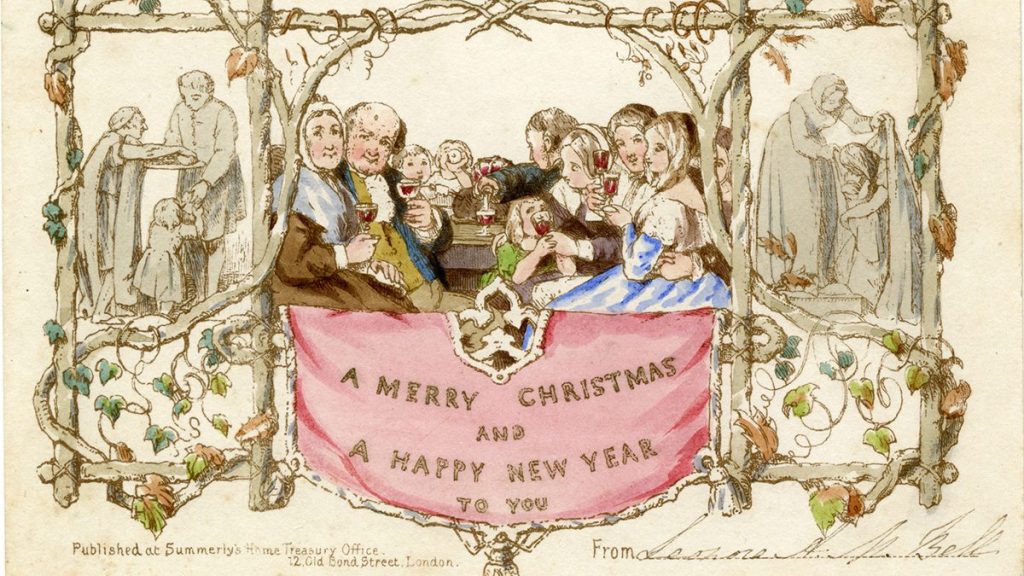
The first commercially produced Christmas card was produced by J.C Horsley in 1843 (see image below). One of these was auctioned in 2001 and sold for £22,260 (presumably it didn’t then get lost in the post).

Like so many Christmas traditions, the Christmas card took off in the Victorian era, aided by increasingly cheap printing methods and the introduction of the penny post (previously postage had been expensive and the recipient usually bore the cost).


The smallest ever Christmas card was created in 2017 but no image exists of it for the reasons outlined below (from the Guiness World Records website):


In December 2017, the National Physical Laboratory in Teddington, UK, used a beam of ions (positively charged atomic particles) to etch a Christmas card only 15 x 20 micrometres (0.0006 x 0.0009 inches) in size. Using a substrate of platinum-coated silicon nitride, the card is a true folded 3D shape, with the Christmas greetings message etched on the inner side of the card. The greetings card is so small that when an electron microscope was used to “photograph” the card, it pinged off the stand and was lost somewhere within the microscope itself.


The above Christmas cards are remarkable but today Alison shares some thoughts on what is remarkable in every Christmas card.

Christmas card connections (by Alison Thursfield)

December again, and the Annual Review of Christmas cards. I have a record of cards both sent and received each year since 1994 and it makes interesting reading. Nowadays the numbers sent and received are different as one loses touch with some people while new names are added, but this is a chance to think of friends and family who are no longer with us. 

Thinking back, I recall memories of people and events, from the big occasions to the very small; of plans made and problems shared; of laughter and camaraderie.  All come from the friendship and experiences shared over the years.

I am glad to be able to look back and enjoy my memories and I feel very blessed, not just at Christmas while writing cards, but all through the year. My list may change over time but for that I am grateful, as making new friends who I hope will become “old” friends is one of the pleasures of life. 

Now back to writing Cards!

In praise of food seconds (by Mark Tribe)

Today, let us give thanks for the resilient earth that feeds us, even as the days grow short.

I wouldn’t normally call my greenhouse (or my green fingers) blessed, but I have a tomato that defies the calendar. I also still have apples clinging to my tree. Literally in one motion I can pick them, bring them to my mouth and taste them.  Rather than food miles (the distance between where food is grown and eaten), I think of food seconds. They may not be as sweet as a summer tomato, pea or strawberry. But the act of eating such freshness is a blessing. It is the taste of now. It is the taste of life persisting against the frost.

I feel privileged to eat from the source – an act of communion with the soil and nature itself. 

May your day be filled with fresh pickings…

Day 14: Walking the Cotswold Way (by Tony Matthews)

Since leaving my beloved Malvern hills in a somewhat unplanned move to Cheltenham I have found new joys in exploring the Cotswolds.  At first, I thought that the hills were just a little too far away and that we would have to drive everywhere, but recently I have discovered that Cheltenham is a very good base for tackling the Cotswold Way (or at least the first bit of it) in 10-mile stages using public transport to start and finish each day.

Of course, as we all know, buses and trains can be an excellent way to travel but they can all to often let you down.  And so it was when it came to my planned walk from Dowdeswell to Birdlip.  Although I had carefully checked the bus timetables and picked a perfect Autumn day, it all went wrong when I asked the bus driver if he could drop me off at The Reservoir Inn.  “I’m not going anywhere near there, mate”!  What?!  Well, what I hadn’t realised, and the timetables hadn’t told me, was that the closure of the A40 at Charlton Kings meant that the bus was diverted miles away out to Seven Springs.  Grrrr!

But now for the blessing!  Dear reader, the day was not lost.  Fortunately, I had the right maps and timetables with me to get a later bus out to Painswick and do the next leg of the walk in reverse back to Birdlip.  A lovely walk on a beautiful day.  Blessed indeed.

Ed’s note: Here’s a piece of music that captures that sense of calm that can be found in walking in nature (with apologies for the inevitable ad at the beginning).

Day 13: The blessing of supportive health professionals (by Anita Mansell)

This year I have witnessed a friend’s death and another friend’s serious life-threatening illness. It has been a sad and often frightening time for them and their families and friends. The expertise, kindness, compassion and care of health professions has been so crucial in ensuring my friends were heard and seen and given the attention they so desperately needed.

I, like many people my age, often seek the expertise of health professionals whether they are from the western medical model or alternative practitioners. I am hugely grateful for the knowledgeable care I receive that nurtures and restores (some of the time) my not always compliant body and mind!

I recently had to make another appointment to see the neurologist. I was apprehensive as I feared he might say I had reached the end of the road in terms of medication…again. But pharmaceutical research has produced new medication and he was able to reassure me positively that this was likely to improve things . Just what I needed to hear!

I feel so grateful that I have access to a health service that, at the time of writing, is free at the point of demand, and despite all its shortcomings is a resource that many of us would lead lesser lives without. 

I am also grateful to those amazing people who provide such skilled services of massage, acupuncture, chiropractor, and kinesiology, the unsung army of professionals who enable me and many others to lead healthier happier lives.

I hope as the days get shorter we can remember those who are not as healthy as they would like to be and those who do not have access to supportive health professionals.

Day 12: Lessons from the rat race (by Tim Cobbett)

They say that ‘success has many fathers, but failure is an orphan.’

On that basis, the phrase we looked at one of our recent ‘Thought for the Week’ sessions – that ‘The problem with the rat race is even if you win, you’re still a rat’ must have connected with those hearing it over the years – as there are several claims to it.

It is most commonly accredited to comedian Lily Tomlin, from a stand-up set in the 1970’s. But other mentions include a biography of Jackie Gleason in the 1950’s, a clip of commentary of a New York Yankees baseball game in the same decade and a reference in ‘Life’ magazine a decade later.

Pre-dating these references, I didn’t hear it in any of those places but in the Sunday evening Church youth group I attended as a teenager at my local Baptist Church.

At that age, seeing what is around you and what your peer group are doing is a powerful influence. The youth group leaders saw it as their role to encourage to consider less obvious or counter-cultural options, informed by their faith.

One week the discussion turned to what everyone wanted to do when they left education and became an adult, and the phrase was used in considering whether winning ‘the rat race’ of conventional success in life of jobs, titles and money, was a worthwhile endeavor. 

The question is still worth some thought now. Not to say that achieving things and working hard can’t be worthwhile, but sometimes we find some of the things we might to do to achieve success conflicting with other values we may hold dear.

Is it better to be what we consider to be a good person, living a good life, even at the expense of some measures of success? 

The question arises not just as individuals but as Unitarians.

How much and in which ways do we think that our movement should be different from those of wider society or of other religious or spiritual movements?

These thoughts are often particularly prevalent at this time of year.

There are a variety of traditions and events that loom large over the Christmas period.

For some Christmas is a Christian festival, the message of which could be seen as profoundly counter-cultural in this context, as Jesus is born in lowly surroundings far from the political and economic centre of gravity of the time – yet with a mission to convey a deeper truth.

The pressure to be a success is never far away at Christmas either though – with the focus on family and on gifts, there is a sense of trying to keep up, even if we are putting that pressure mostly onto ourselves.

There is a strong sense of an ideal Christmas we should be living up to, even if none of us have ever actually experienced such a thing.

 All in all, a time when a chance to strip back the trappings and consider what we think really matters, in the company of our fellow Unitarians, can be especially valuable.

Day 11: Exercise is a walk in the park (by Kevin Watson)

I used to dread PE lessons at school. If it was football, the teacher always divided us into shirts and skins, and the skins had to take their shirts off for the duration, even though we had reversible tops. We’d be stood there, shivering in the cold and indignity of the situation, whilst the kids who were good at sports picked their teams and, of course, I was always one of the last picked.

The way I remember it is straight out of the classic film Kes. I would do everything I could do avoid contact with the ball and when put in goal I would wander off for a chat if I saw a friend passing by or hang off the goalposts whilst the ball dribbled in underneath my legs. “If you’re all that bothered about the ball not going in the back of the net,” I said one day, “why don’t you just board it up?’  That did not go down well.  I had no competitive spirit whatsoever, and the effect of a weekly double lesson of PE was exactly the reverse of what it ought to have been.

I wasn’t the only rebel in the school. For a while, we were allowed to choose unaccompanied cross-country running until the teacher worked out that we were running out of sight and then going to one of the lads’ houses for a cup of tea and a chat instead of a run. We would splash water on our faces and try to look out of breath, but I suspect we overacted and ultimately we were rumbled.

After leaving school I never had any interest in playing a sport or joining a gym and now here I am decades later working in a department at Oxford Brookes University where most of the team are ridiculously fit. In a sea of slim, trim and muscular people I am the Michelin man by comparison, and each winter I make the same joke about how underneath all of these layers of clothing I am wearing because of the cold weather is a 28 inch waist.

One of the things I am grateful for, this year, however, as the person who is aware that he is probably the least effective at physical self-care in my department, is that I work in a culture of gentle encouragement. We have a scheme that is called Green Impact, and at one level it is about taking better care of our planet by thinking about how we use resources, but there is also a lot in it that is about physical and mental self-care. People come up with little ideas that have a profound difference – we had a ‘leave your phone downstairs’ week, which was about promoting better sleep and good mental health by making us less stuck to our digital devices, we have had sustainability shared lunches, where people have shared food and recipes, and there have been challenges to gentle physical exercise – getting away from the desk for 10 minutes, doing hourly stretches, taking a walk outside.

I was on one of these Green Impact walks in late October, listening to a learning development podcast because that felt like the only way to justify not being at my desk. The guest on the podcast was asked about the need to pay attention – he said assume multi-tasking is not possible – stop what you are doing and pay attention to where you are, what is going on around you and how you feel.

So I did. I switched him off and noticed that I was breathless because of the pace I had been walking at. I noticed that it was a pretty nice day that I had been in a hurry to get back to work from and I hadn’t really taken the time to take in the details of it (I took the pictures below on the way back).

I was aware that it was the gentle persuasion of other people that was getting me outside in the open air.

And finally I noticed that refreshed feeling you get when you have been moderately exercising for a while.

Happily, there wasn’t a goalpost in sight.