Back in the mid-90s, before we all got distracted by the internet, in a time when people didn’t get excited by phone updates because a phone was just a thing attached to the wall that distracted you by ringing every time you took a bath, I was influenced by Garrison Keillor.

I first read Garrison Keillor’s Lake Wobegon Days in the late eighties or nineties, and then when I went to college in Ripon, Wisconsin in 1993 there he was on the radio every week, presenting a weekly show that seemed to be from a different era despite its contemporary cultural references. Prairie Home Companion combined stories from Lake Wobegon with sketches from the Lives of the Cowboys and Guy Noir, music from some of the great American folk and Americana singers of the time and faux-advertising from Powdermilk Biscuits and the Ketchup Advisory Board. It was gentle, warm and inoffensive and as I travelled around small town America as an undergraduate and then later for my PhD research, the whimsical qualities of Keillor’s depiction of small-town life played into my own feelings about these places where I enjoyed a warm welcome wherever I went. Because it was a time before the internet when life was less busy I even started writing my own midwestern stories, and looking back, I don’t think I started badly:
It was a wild land once. However, civilized times turned the midwest into a landscape of regimented fields of corn watched over by Sergeant⌐Major silos. A new arrival takes a wrong turn and travels ten to a place he has never been before only to find that it is, somehow, familiar. Everything is the same here to the eyes of the new arrival. He gets in his car and drives off wondering what the appeal of this part of the world could possibly be, searching for the meaning he might have found if he had stayed long enough to sample Ethel Ingersoll’s cherry pie.
Life has no point if you stay on the interstate. Anyone can do that. The interstate is just traffic travelling in two directions known as “there” and “back again”. Someone drives to the office, sits in his chair for eight hours wondering why, and then drives home again. “Back again” is that route which looks much the same as “there” and has no point except coffee stops, burgers and Dunkin’ Donuts. Life has no point if you stay on the interstate. Take the county roads. Better still, find a dirt track with ruts in it that challenge tyres and keep a person on edge. Get completely lost and you might find yourself where you want to be.
After a promising start that story took a left turn into absurdity and whilst I enjoyed writing my stories they all turned into indulgent shaggy dog tales with under-developed characters and wince-inducing punchlines. The first one, for example, was about an old soldier who lived to be over a hundred and attributed his longevity to the spoonful of gunpowder he put on his cornflakes in the morning. “It cleans out the tubes,” he explained. Several pages later the old soldier died leaving, as the last paragraph explained, a widow, three children, ten grandchildren, twenty-five great grandchildren and a huge crater where the crematorium used to be. I was, I learned, not a great writer of fiction.
Whilst I am no great writer of fiction, I can see the work of Garrison Keillor in various aspects of my life. For example, he once said, “When in doubt, look intelligent,” which was a strategy I used to get through the first two years of my PhD, by which time it was too late for anyone to tell me how woefully underprepared and unqualified I was for the journey I was on. Later on, when I was writing a chapter on the pay and working conditions of Primitive Methodist ministers in Britain and the United States, I heard him tell a story of a Lutheran pastor contemplating asking for a pay rise with the words, “It’s kind of like asking for cheese on your communion wafer: you just don’t!” and I realised that in one line he has summarised the point of my entire chapter.
Like Keillor, I have always thought that humour is an important way of making sense of the world. “The highlight of my childhood was making my brother laugh so hard that food came out his nose,” he once said, but when I led a service on the theme of the spirituality of humour, the Garrison Keillor quotation I chose was this:
“Humor is not a trick or a joke put into words. It’s a presence in the world, like grace, and it’s there for everyone.”

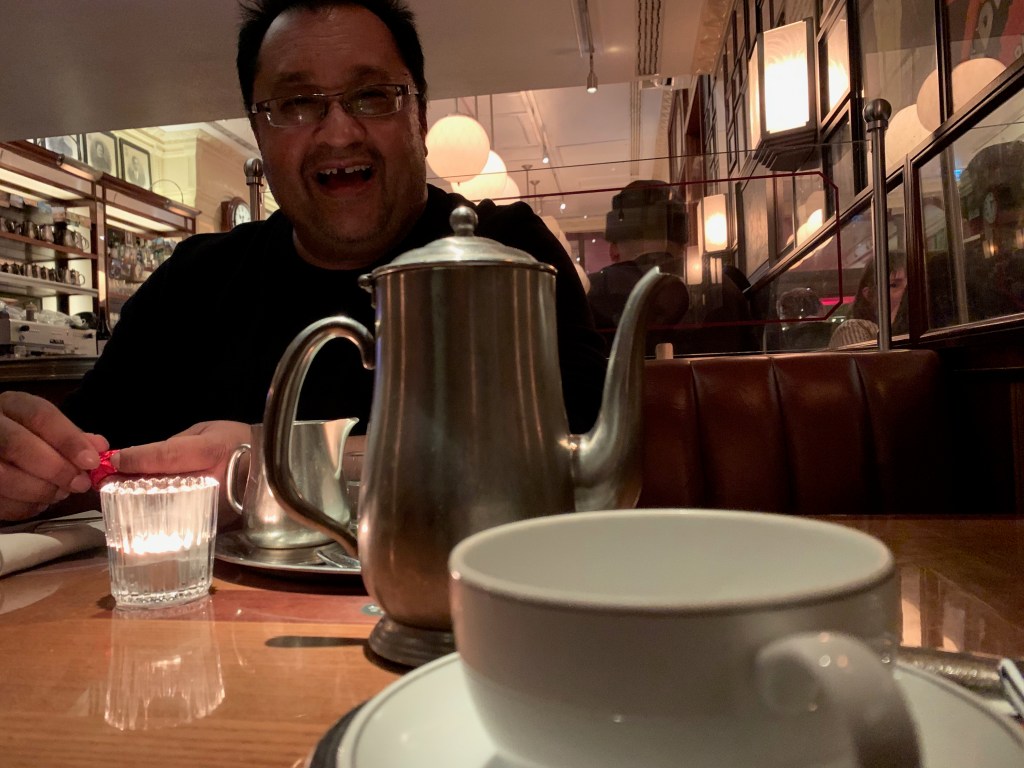
With all the above in mind, you will appreciate that I was excited to finally see Garrison Keillor live when he visited London in October. Accompanying me was my old friend, Ru, who enjoyed a few midwestern adventures with me many years ago. One of the many things I find fascinating about Garrison Keillor is the extent to which he comes across as a preacher, albeit one whose sermons are peppered with risque jokes that wouldn’t get past the pulpit censors. Keillor is 83 now and has difficulty moving around, but he mesmerised us for two hours with stories, hymns and occasionally risque jokes all around the theme of cheerfulness. We were made to sing together, laugh together and think together and when we came out Ru and I went for coffee and ice cream, for no better reason than that is something you can easily do in London at 10 pm on a Thursday evening. Ru shared stories of his dad, who passed away earlier in the year, and somewhere in the telling and the listening and reminiscing life felt deeper and richer. I came away grateful for the many adventures Ru and I have shared, grateful for all those visits to Lake Wobegon and places like it, and also grateful for the power that is to be found in telling our stories and listening to the stories of those with whom we travel.
 Living in the Moments