
Recently I read Stephen Walker’s fascinating account of the race between the United States and the Soviet Union to get the first man into space and I found it entirely riveting (thank you £4 bookshop in Bristol for another gem). It is a story that I was not so familiar with because it lives so much in the shadow of the moon landings, and perhaps the particularly elevated Cold War tensions of the early sixties make it less easy to draw inspiration than later adventures in space. It also doesn’t help that before Yuri Gagarin ever got to the launchpad, quite a number of animals, including numerous dogs were blasted into space to test the science, their return to Earth prevented not just by the trauma of the trip but bombs in the capsules, programmed to detonate and destroy everything if any spacecraft should go off course and be in danger of landing outside Soviet territory. Indeed, one rogue KGB officer argued the case that Gagarin should be accompanied by a bomb on his trip beyond the sky (as if he wasn’t effectively already sitting on one), the plan being that this would be an effective deterrent for a cosmonaut considering defection. With Gagarin there was never the remotest risk of this. His achievement was remarkable, and his charm considerable, although when first asked by Nikita Khrushchev, what it was like to be the first man in space, he said something like, “I saw the Earth, from really high up.” Maybe something was lost in translation.
I was only seven months old when Neil Armstrong came up with a better line to describe walking on the moon, but that was such a momentous moment in human achievement that it resonated through my childhood and many people’s at that time. Perhaps that is one of the reasons I draw so much inspiration from stories of space – they can remind us of the capacity of human beings to do things that seem impossible. Until the Soviets beat the Americans into space, President Kennedy was reticent to spend much money on the space race but he was galled by Gagarin to such an extent that he promised the moon by the end of the decade. Fear of what Soviet dominance of space might mean might have been the catalyst, but the result was the achievement of something many on Planet Earth would have thought impossible. On the fiftieth anniversary of the moon landing, I heard the scientist and broadcaster Kevin Fong at the Cheltenham Science Festival making the claim that if we put the same kind of energy and resource into tackling global warming as went into the space race of the 60s and early 70s, we could really solve it. “Houston, we have a problem,” said Tom Hanks, echoing astronaut Jim Lovell, in Apollo 13. Well of course we do have a problem, perhaps many problems, but the stories of space are a reminder that human beings can and do achieve great things, sometimes beyond what we might think is possible. “I know the sky is not the limit,” said Buzz Aldrin, “ because there are footprints on the moon and I made some of them.” Not many of us can make such a claim but there is a universal point here that is worth taking to heart.
One of the less profound reasons that I am fascinated by space exploration is that it has been the subject of some great films, many of them of the ‘pin you to the back of the seat with tension’ variety. In Gravity, Sandra Bullock is an astronaut battered by meteor storms whilst orbiting the Earth, who ends up stranded. It looks like she will surely die. She has a terrifying infinity of space all around her but like so many space stories this is really a story about the still, small spaces within us. In the end, (spoiler) she gets back to Earth, but it’s not just Earth it’s Eden; she is reborn and we are in the terrain of T.S. Eliot:
We shall not cease from exploration
And the end of all our exploring
Will be to arrive where we started
And know the place for the first time.
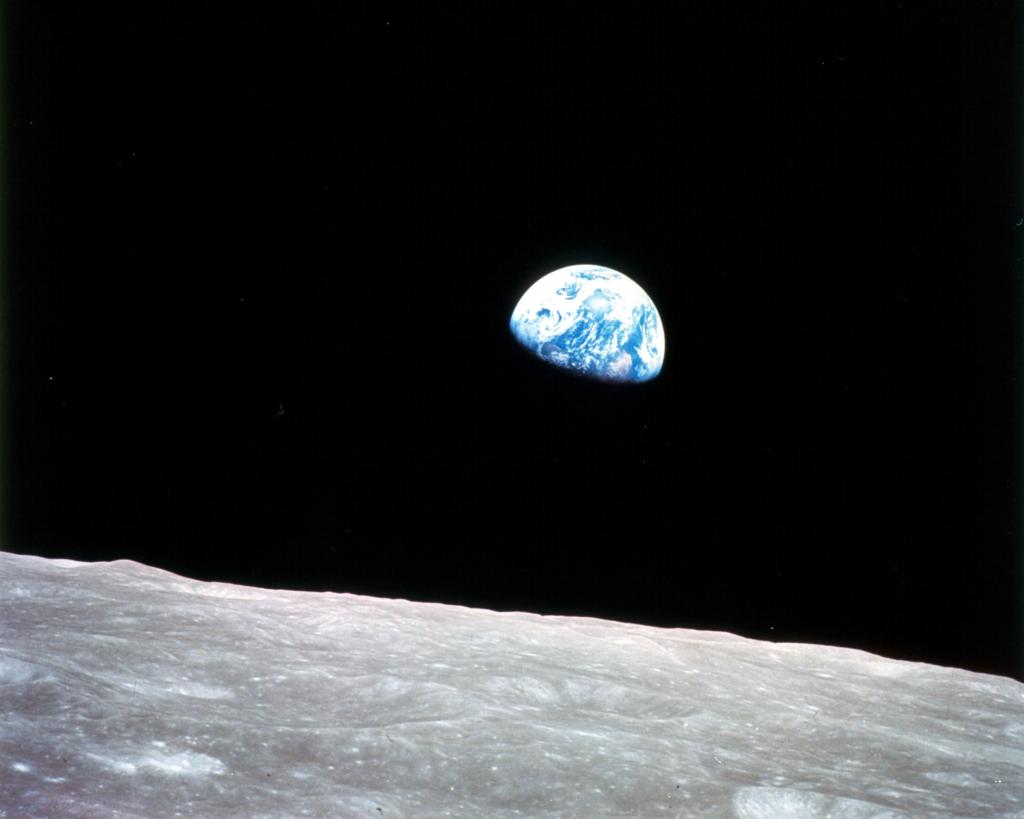
Real-life journeys into space have also given humans new perspectives on this Spaceship Earth we call home, perspectives that are not all about what is out there in space but how we are down here on Planet Earth. On Christmas Eve 1968, William Anders took a photograph of Earth from the vantage point of an orbit around the moon and this image became known as Earthrise. The planet appeared as a bauble in the night sky, a beautiful but fragile Christmas decoration, possibly easily broken if not looked after. It is one of the most significant images of the twentieth century because it has the power to make us see ourselves and our world so differently and hopefully inspire us to look after the planet we share.
I never would want to go into space because the journey sounds horrendously uncomfortable and I’ve known fairground rides that can make me about as sick as I can stand. Even the medical procedures that the Soviet Cosmonauts were put through as part of their preparation would have me running off to hide in a bunker rather than volunteering to be blasted into space. Still, like all of us I’m made of the stuff of the universe, I am a tiny part of the infinity that is out there inviting us to make our reality bigger, whether we are looking at our feet or the night sky. There are apparently 200 billion trillion stars in the universe, most of which we know nothing about. Space is not just the last frontier, but an immensity of overwhelming mystery. It speaks to me more of what I don’t know than what I do and I find that strangely comforting, because ultimately in stories of space whether real or imagined, I find echoes of spirituality, that sense in which religion is not about possessing the truth as no one can have the whole truth. Instead, we are on a journey into mystery, a journey to be made with open minds and hearts, a journey to be made with humility. We won’t find all the answers on this journey, but the hope is always that there will be enough to help us navigate the meteor storms of life, and find our way home.
 Living in the Moments